

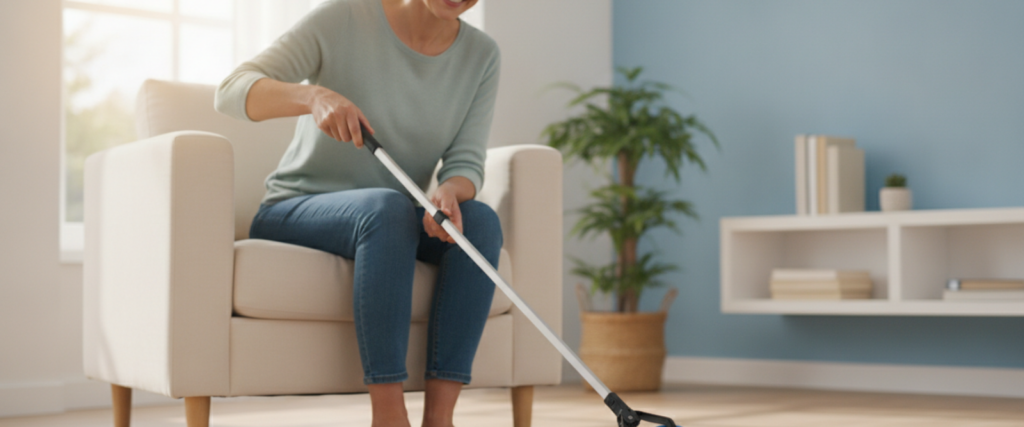
This guide explains NDIS low-cost assistive technology for daily living aids: what the NDIS counts as low-cost, how participants buy it from their plan, and which everyday aids usually fall into the group. Along the way it links each type of aid to the matching range in the Allcare Warehouse daily living aids catalogue, so you can see real examples of what is described.
Key Takeaways
- Low-cost means under $1,500 per item and nothing custom-made or modified.
- The money comes from consumables in core supports, which the NDIS says covers small aids for everyday tasks such as eating and dressing.
- For a low-risk item in that price range, no quote, assessment or prior approval is needed when funds are available.
- A few inexpensive items, bed poles among them, are treated as higher-risk and need written advice.
- Only NDIA-managed participants are limited to registered providers for these purchases.
What counts as low-cost assistive technology under the NDIS
The NDIS defines assistive technology as equipment or a device that helps you complete tasks you might not be able to because of your disability, in areas such as mobility, leisure and self-care. Its low-cost group covers anything under $1,500 that you can usually buy from a store or online, since nothing about it has to be made to measure or modified, and that you generally will not need advice or set-up support to start using safely.
A low price does not make an item fundable on its own. The same NDIS guidance lists five things that still have to be true:
- It is directly related to your disability.
- It will help you work towards your plan goals.
- It is something the NDIS rules say can be funded, which in practice means an NDIS support.
- It is safe for you to use.
- It is supported by evidence, for example a recommendation from your allied health professional.
Cost is also not the only line the NDIS draws. It separates low-risk items, such as a non-slip bathmat or a shower stool, from higher-risk assistive technology, which needs written advice before buying or renting it. Some low-cost items sit on the higher-risk side, and the NDIS gives weighted blankets and bed poles as examples.
Everyday aids the NDIS lists as low-cost
The NDIS gives examples of low-cost items, grouped by area of life. They illustrate the category rather than limit it, because what you need depends on your situation and goals:
- Mobility: walking sticks or canes, short portable ramps and four-wheeled walker frames.
- Communication: screen magnifiers and text to voice apps.
- Bathing and toileting: shower chairs, hand showers, handrails and incontinence alarms.
- Household support: modified eating utensils, washing line adaptors, talking kitchen scales and adjustable-height chairs.
Its description of the consumables category goes further for daily living. It names non-slip bathmats, along with small devices for tasks such as dressing, eating, drinking and cleaning, as low-cost assistive technology you can buy with consumables funding, and that is the group most of the aids below belong to.
Daily living aids that usually fit the low-cost group
These ranges hold off-the-shelf aids for the tasks the NDIS describes. Whether a particular item suits your plan still comes down to the five conditions above:
- Eating and drinking:
- The eating and kitchen aids range includes Caring Cutlery, with contoured handles for a weak grip and restricted wrist or finger movement, and a Rocker Knife for upper limb weakness or limited wrist movement.
- For one-handed meals there is a Plate Surround that clips onto a dinner plate, the Nelson Knife, whose pronged end doubles as a fork, and Dycem non-slip mats that grip on both sides without adhesive.
- Cups include the Two Handled Mug, supplied with an anti-spill lid and a spout lid, and the Clear Caring Mug, described as useful for people with tremor or who cannot sit upright.
- Dressing:
- The dressing aids include the Kings Button Hook for one-handed dressing and the Leg Lifter, a webbing strap with a hand loop and a stiffened foot loop for moving a leg that is hard to lift.
- A long-handled brush and combs suit people who have difficulty raising an arm or reaching behind their head.
- Around the house:
- Among the household aids are reachers, a Crystal Tap Turner that clamps around cylindrical tap tops, a Double Key Turner with a built-up handle, and Easigrip Scissors with spring-open loop handles.
- For reading and writing, there are book stands that hold pages open, magnifiers, and a pen and pencil holder for a weak grip.
Start from the hardest task in the day, not from the catalogue. The aid worth buying is the one that removes that particular barrier.
Kitchen preparation, medicines and night-time aids
Some aids are built for a single kitchen job. The Cordless Kettle Tipper holds a jug kettle on a raised wire frame that pivots with gentle pressure on the handle, so water can be poured without lifting the kettle. The Electric Tin Opener opens tins one-handed with one-touch operation, and the Belliclamp jar and bottle opener hooks over the edge of a benchtop and clamps the jar with a sliding arm you can push with your hip.
Medicines are easier to keep track of when each dose has its place. The pill organisers range runs from one day boxes to seven day boxes with morning and night compartments, along with a day-out box and a pill cutter.
At night, falls prevention alarms alert a carer when someone leaves a bed or chair, or sits up in bed. The range includes pressure pads and a floor alarm that can be placed at the bedside or by a doorway.
Comparing aids before you buy
Two aids that do the same job can suit very different hands, kitchens and routines, so it helps to compare a few on the features that matter to the person using them.
The product descriptions point to six practical questions:
- How strong is the grip? The Easy Reacher has an ergonomic full trigger that asks for very little finger extension, while the Helping Hand Featherweight uses a pull-type trigger that needs only minimal hand movement.
- Will it be used with one hand? The Nelson Knife, Plate Surround and Electric Tin Opener are each designed for one-handed use.
- Is bending or reaching the problem? Long-handled shoe horns, stocking aids and the 790mm Long Handled Dust Pan and Brush all cut down on bending.
- Fixed or free-standing? The Undo-it jar opener screws underneath a shelf or cupboard, while the Spillnot sits on the bench on non-slip feet.
- How will it be cleaned? The Medici Cup is microwave and dishwasher safe, the Two Handled Mug is dishwasher safe but not for the microwave, and the Insulated Mug suits neither.
- Does it fit what you already own? The Plate Surround suits plates from 200mm to 280mm across, and the Crystal Tap Turner works on taps up to 60mm in diameter.
Narrow it down to two or three options for each task, then take that shortlist to whoever advises on your equipment. The advice section further down covers who that can be.
How to buy low-cost assistive technology from your plan
The NDIS sets out three steps for buying low-cost assistive technology: check your plan, find a provider and make a claim.
Check the consumables budget
The funding sits under consumables in your core budget. Check the balance in the participant portals or the my NDIS app, or ask whoever helps with your plan. If the item costs less than $1,500 and the funds are there, you do not need to check with the NDIS first or send a quote for approval. When consumables run short, core supports funding is flexible and can cover the purchase, and if there is no flexible funding the NDIS can discuss other options, such as a plan variation. More expensive items follow a different process based on three cost bands:
- Low-cost: under $1,500 per item.
- Mid-cost: from $1,500 up to $15,000, needing written evidence from an allied health practitioner or other assistive technology advisor, though not a formal assessment.
- High-cost: over $15,000, needing a report from a qualified assistive technology assessor and a quote.
Who you can buy from, and who claims
The second and third steps depend on how the plan is managed.
A plan can also mix management types, for example core supports self-managed and capital supports NDIA-managed, so check which applies to your consumables budget before you order. The NDIS buying steps then differ by type:
- NDIA-managed: only a registered provider can supply the item, and it claims payment directly from the NDIS.
- Plan-managed: any supplier is fine, and you pass the invoice and any required documents to your plan manager, who handles the payment and the claim.
- Self-managed: you can buy from any supplier, pay upfront, then claim reimbursement through the my NDIS portal, the myplace portal or the my NDIS app.
Self-managed buyers should keep every receipt and related document, because the NDIS can ask for proof of a claim. For items above $1,500, our assistive technology funding guide walks through the evidence and quote steps.
Send through the product names you are weighing up and how your plan is managed, and the team can talk you through the differences.
Getting advice before you buy
The NDIS suggests getting advice before buying any assistive technology funded in your plan, low-cost items included. That advice can come from an assistive technology advisor, who may be an assistive technology assessor or mentor, or from your medical practitioner or specialist if they have enough experience with what you need.
According to the NDIS, an advisor helps you:
- learn what assistive technology is available
- choose the best options for your needs
- check the item is safe for your situation
- set up and use the item
- follow safety and set-up instructions, especially for higher-risk items.
Plans with assistive technology funding also carry at least $500 for advice from an advisor, according to the NDIS. Assessments are not something Allcare Warehouse provides, so line up advice through your own therapist or advisor. Our article on OT assessments explains when a formal assessment is needed for NDIS equipment.
Ordering daily living aids from Allcare Warehouse
As a registered NDIS provider, Allcare Warehouse can take orders from NDIA-managed, plan-managed and self-managed participants alike.
The website works as a showroom catalogue: nothing is priced online and there is no cart, which means every order is placed by phone, by email or in person. A typical order runs like this:
- Note the product names from the listings, including any size or length option.
- Have your plan management type ready and, if you are plan-managed, your plan manager’s contact details.
- Get in touch through the contact page or visit the Liverpool showroom.
- Choose delivery or pick-up:
- Delivery covers Sydney, with freight available within NSW.
- Listings show delivery as available Australia wide.
- Orders can also be collected from the Croydon Park store and pick-up point.
- Keep the invoice with your plan records, or send it to your plan manager.
Each step is set out on the how to order page, while delivery areas and collection are explained under delivery and pick-up.
Frequently Asked Questions
Can I rent or trial assistive technology instead of buying it?
Yes, in some cases. The NDIS says you do not have to buy assistive technology outright and can also access it through rental, loan, subscription or other arrangements. For high-cost items it may ask you to trial or rent first, and it includes funds in your capital budget when a trial is needed. Allcare Warehouse supplies equipment for purchase only, so talk to your advisor if renting suits you better.
Are continence products counted as low-cost assistive technology?
The NDIS describes continence products as everyday items in the consumables category, separately from low-cost assistive technology, while incontinence alarms appear in its list of low-cost examples. Both are paid from consumables funding. Our guide to continence aids and the NDIS covers assessments, plan types and ordering for those products.
Can NDIS funding pay for ordinary household items?
Generally not. Under the reasonable and necessary criteria, funded supports cannot include day-to-day living costs. The question is whether the need for the item comes from your disability, rather than it being something every household buys. The NDIS Would we fund it guide explains how planners typically decide on commonly requested items, including household items.
How do I get low-cost assistive technology included in my plan?
Tell the NDIS which types of low-cost assistive technology you might need, because its guidance says it needs that information to include them in your plan. NDIA planners decide what to fund by weighing the information and evidence you give them, so a written recommendation from a therapist or other allied health practitioner, where you have one, strengthens the request.
Bathroom items in the same funding group
Several of the bathing and toileting examples above are bathroom equipment rather than daily living aids. Our shower chair buying guide and grab rail placement guide cover those in depth, and the shower stools and rails ranges sit in the bathroom aids section.
To see aids before you order, visit the Liverpool showroom at Shop 7 inside Northumberland Arcade, 230 Northumberland Street, or call 1300 767 777 to talk through your shortlist.
Related resources
- Do You Need an OT Assessment for NDIS Equipment?
- NDIS assistive technology funding guide
- Guide To Choose Quality Cutlery Sets For Those With Weak Grips
- Fall Prevention Equipment for Seniors
- Continence Aids & NDIS: What’s Funded and How to Order
- What is the NDIS? A guide for equipment buyers
- Walking Frame vs Rollator: Choosing the Right NDIS Aid
- Home Modifications vs Assistive Equipment
- Carer Support: Essential Equipment Guide
Send your shortlist and plan details to the Allcare Warehouse team, and they will help you put the order together.
This guide is general information, not medical advice. Read our disclaimer.