

Safe patient transfers at home protect two people at once: the person being moved and the carer doing the moving. Shifting someone up the bed, from bed to chair, onto the toilet or into the car can happen many times a day, and each move that relies on lifting by hand is a manual handling risk for the carer. This guide explains the main types of patient transfer equipment, from simple slide sheets to mobile hoists, what each is designed for, and why training should come before first use.
From its Liverpool showroom, Allcare Warehouse supplies the transfer aids that families and support workers use every day, from friction reducing sheets to sit-to-stand platforms. The examples below are taken from each product’s own description.
Key Takeaways
- Lifting a person by hand is a hazardous manual task, and equipment is there to reduce it.
- Slide sheets and boards reduce friction so a person can be slid rather than lifted.
- Belts, turntables and standing aids suit people who can bear some weight.
- Mobile hoists with the right sling move people who cannot help with the transfer.
- A physiotherapist or occupational therapist should choose the method and train the carer.
Why safe patient transfers at home need a plan
Safe Work Australia defines hazardous manual tasks as including lifting, lowering, pushing, pulling, holding or restraining a person where the task involves repetitive movement, high or sudden force, or sustained or awkward postures. It links these tasks to musculoskeletal disorders such as back injuries, sprains and strains, and lists mechanical aids and training among the ways to reduce the risk. For paid carers, SafeWork NSW names patient handling among the risks aged care workers face and notes that a client’s home is a workplace when care is delivered there.
That guidance is written for workplaces, but the approach is a sensible starting point for manual handling for carers of any kind: look at each move, ask whether it can be done without lifting, and use equipment where it can.
Moving in bed: slide sheets and positioning
A slide sheet reduces friction so the person can be slid up the bed or turned rather than lifted. The Slide Sheet in the slide sheets and positioning range is folded over and placed under the person, so one layer slides over the other, and is described as reducing the risk of strain or back injury to the carer. For multidirectional moves, the WendyLett 4 Way Sheet sits on a WendyLett Base Sheet, whose anti-slip sides help stop the person sliding off the side or down the bed.
For lying transfers, such as from one bed to another, the Easy Glide Transfer Board in its oval form is used when the person cannot be turned to the side, and needs a firm surface on both sides with a gap of no more than 5 cm.
Sitting transfers: boards, turntables and belts
A transfer board bridges the gap between two seats, for example a wheelchair and a bed, so the person can slide across. The Easy Glide Transfer Board 3 Fold assists sitting transfers to beds, toilets and car seats, and has non-slip tape underneath so it stays put. The Curved Transfer Board follows the natural sweep of an assisted transfer and lists a 150 kg maximum user weight. A foot stool from the positioning range is often used with a sliding board.
For people who can stand but struggle to turn, the Patient Turntable is a swivel platform for standing rotational transfers, rated to 125 kg. The Handy Soft Turn Pad does a similar job from a seated position.
A transfer belt gives the carer firm handles to hold while supporting the person. The Rebotec Seat To Stand Belt is described as fastening snugly around the lower abdomen and hip area, as close as possible to the person’s centre of gravity. The Padded Walking Belt has four padded vertical handles and fits a chest or waist of 600 to 1250 mm.
If a move needs lifting by hand, it is worth asking whether there is equipment that can do it instead.
Standing aids and standing hoists
Some people can take weight through their legs but cannot rise or turn safely alone. The Quick Move supports sit-to-stand transfers for people with impaired balance and reduced leg strength, but its description makes clear the person must have some arm strength and be able to bear weight. The Romedic Return is a pivoting platform the person stands on while one carer steers it to a bed, wheelchair or toilet.
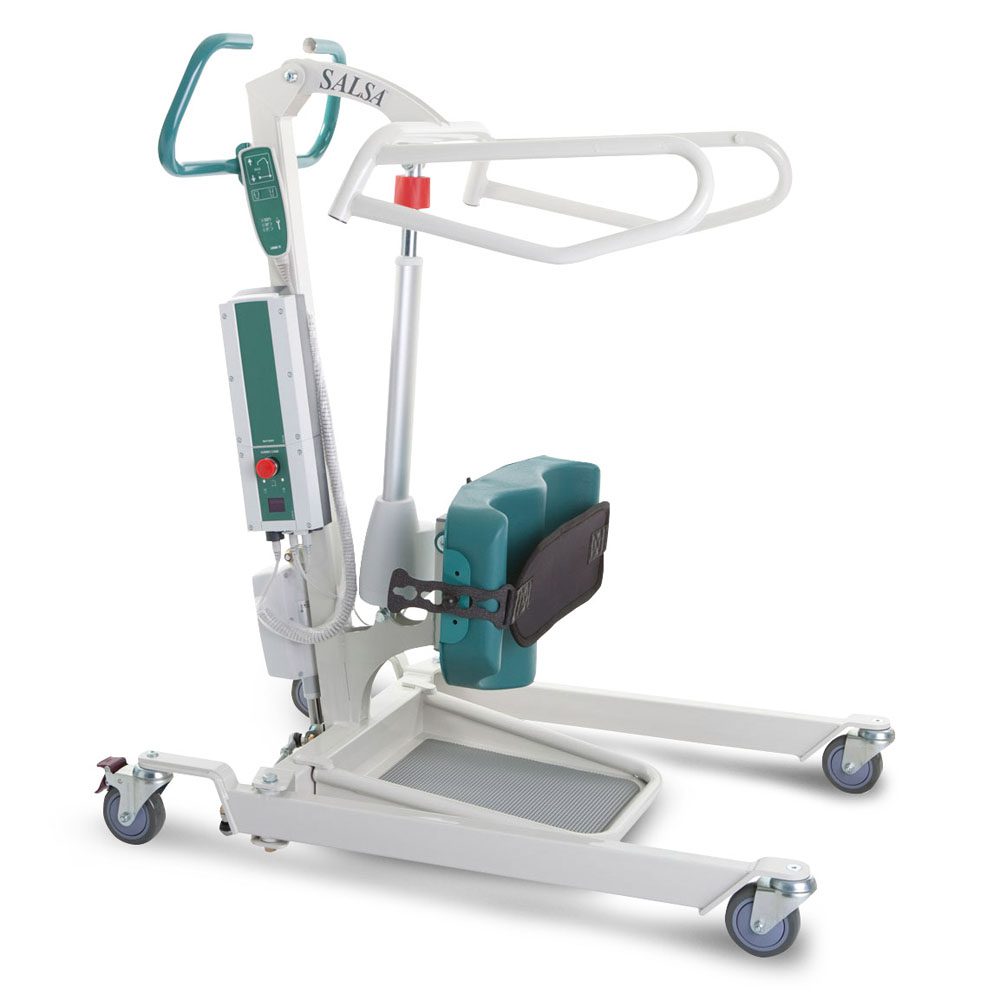
A powered standing hoist takes this further. The Allegro Salsa Hoist is designed to secure a person moving from sitting to standing, with an adjustable knee pad, electric leg spread and removable footplate. Standing hoists use a standing sling, and the Standing Transfer Sling is recommended on standing hoists for weight bearing people only.
Mobile hoists and slings
When a person cannot help with the transfer, a hoist does the lifting. Healthdirect explains that hoists use a sling to lift a person, for example from a bed to a wheelchair or from the floor to a standing position, and that they can be used at home as well as in hospitals. In the patient hoists and slings range, the Allegro Sonata is described as designed primarily for domestic use, while the Allegro Alto is a heavy duty model with electric base width adjustment for situations where a high capacity lift is needed. Both list a 130 mm under-bed clearance, so check the height under the bed before choosing.
The sling matters as much as the hoist. General Purpose Slings fit only hoists with a yoke attachment, have colour coded webbing loops for sizing, and come in a mesh version suitable for bathing. The version with head support is described as suited to lifting from the floor and to people who feel less secure. NDIS participants should know that the NDIS lists mobile hoists as mid-cost assistive technology, which needs a recommendation from an assistive technology advisor. Our guide to the patient hoist for home use goes into more detail.
Lift chairs and care seating
Some transfers can be made easier at the chair itself. The lift chairs and care seating range includes rise and recline chairs such as the Capri Chair, whose motion stops at any point when the button is released, and the Aircomfort Chair, with polished timber arm knuckles that assist transfers.
Get trained before the first transfer
Equipment only reduces risk when it is the right equipment, used the right way. The NDIS treats bed sticks and other transfer aids as higher-risk assistive technology that needs specialised advice to buy, set up and use safely, and requires written advice before a participant buys or rents it. Occupational therapists help people find and use equipment, and physiotherapists may also help with aids. Ask the treating OT or physio to choose the method, show the carer each step and watch them practise before they do it alone. Our carer support equipment guide covers other aids that make daily care easier.
Not sure which aid suits the person you care for? Ask about slide sheets, boards, belts and hoists before you decide.
For getting in and out of the bath, a bath transfer bench lets the person sit outside the bath and shift across the seat.
Frequently Asked Questions
Can a transfer board or slide be used to lift someone?
No. Several descriptions say so directly: the Patslide, The Slider and the Timber Transfer Board are each marked not to be used as a lifting device. They are for sliding a person across a gap, and each has its own limits, such as the Timber Transfer Board’s 130 kg maximum user weight. If lifting is needed, that is a hoist’s job.
What helps with getting in and out of a car?
The Car Transfer Bar fits the U-shaped striker plate on the door frame to give a firm handhold, and has a seat belt cutter and glass breaker built in. The Auto Slide cushion attaches to the car seat to help the person turn and move sideways. The long version of the Easy Glide 3 Fold board suits wheelchair to car transfers.
Is there a sheet for someone who needs turning often and is incontinent?
The Top Sheet is designed for incontinent, bedridden users who need turning often. It is placed on top of a friction reducing product such as a slide sheet, spreads the load over the whole body, and uses super absorbent material so the surface feels dry. It is also described as helpful for holding a heavier person on their side during hygiene care.
How can someone be moved back in a chair without lifting?
The One Way Slide sits on the seat of a chair or wheelchair and stops forward movement while allowing the person to slide backwards. The longer version has six draw straps, so the carer does not have to pull on the person directly. A tubular version suits more active users who can reposition themselves.
Building a safer transfer routine
Safe patient transfers at home rarely depend on one piece of equipment, because the bed, the toilet, the chair and the car each pose a different problem. List every transfer in a normal day, note who helps with each, and review the list whenever the person’s strength or the carer’s situation changes. Equipment that suited last year may not suit now.
Related services
Talk to the team about transfer equipment on 1300 767 777, or visit the Liverpool showroom at Shop 7 inside Northumberland Arcade, 230 Northumberland Street, Liverpool.
This guide is general information, not medical advice. Read our disclaimer.