

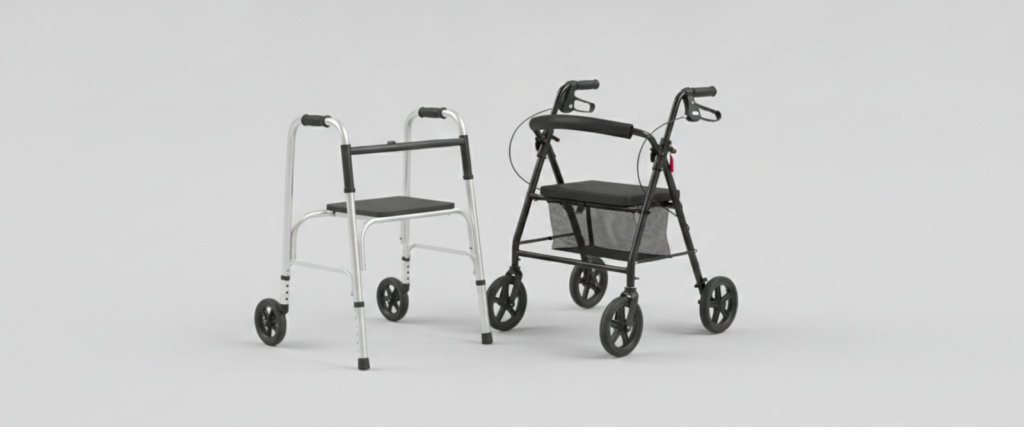
For NDIS participants seeking to enhance their mobility and independence, choosing between a walking frame vs rollator is a crucial decision. Both are valuable types of mobility aids, but they offer distinct features and benefits tailored to different needs. This essential guide will help you understand the structural and functional differences, compare key features, and navigate NDIS funding to find the right aid for your specific requirements.
Key Takeaways
- Walking frames offer maximum stability and support, ideal for users with significant balance challenges.
- Rollators provide greater manoeuvrability with wheels and often include seating and storage.
- NDIS funding for walking aids typically falls under the assistive technology category within Core Supports.
- An Occupational Therapist assessment is crucial for selecting the most appropriate aid based on individual needs and environment.
- Understanding the key differences helps NDIS participants make an informed decision for enhanced independence.
What Is a Walking Frame?
A walking frame, often called a standard walker, is a fundamental mobility aid designed primarily for maximum stability. These devices typically feature four legs with rubber ferrules (caps) at the bottom, providing a firm grip on the ground. Users lift and place the frame forward with each step, requiring upper body strength and coordination.
Key Features of a Walking Frame:
- High Stability: Offers robust support, making it excellent for individuals with poor balance or those needing substantial weight-bearing assistance.
- No Wheels: The absence of wheels means users must lift the frame, which can be slower but provides superior control.
- Lightweight: Most walking frames are relatively light, making them easier to lift and transport.
- Adjustable Height: Frames can be adjusted to suit the user’s height, ensuring proper posture and comfort.
- Folding Options: Many models fold flat for convenient storage and portability.
Walking frames are particularly suited for indoor use, where stability on even surfaces is prioritised. They are excellent for short distances and for regaining confidence after an injury or surgery.
What Is a Rollator?
A rollator, frequently referred to as a wheeled walker or four-wheel walker, represents an evolution in mobility aids, offering enhanced manoeuvrability and additional features compared to traditional walking frames. Rollators are equipped with wheels on all legs, allowing users to push the device forward without lifting it.
Key Features of a Rollator:
- Wheels: Typically comes with three or four wheels, facilitating smoother movement and reduced effort.
- Brakes: Hand-operated brakes provide control over speed and allow the user to lock the wheels for stability when standing or sitting.
- Seat and Storage: Many rollators include a built-in seat, offering a convenient resting spot, and a basket or pouch for carrying personal items.
- Folding Mechanism: Most rollators feature a folding design for easier transport and storage.
- Ergonomic Handles: Often designed with comfortable, height-adjustable handles to promote good posture.
Rollators are generally preferred for outdoor use and longer distances, where their wheels and seating options provide greater comfort and independence. They are ideal for individuals who require support but also value speed and convenience.
Walking Frame vs Rollator: Key Differences
Understanding the core differences between a walking frame and a rollator is essential for making an informed choice. Here’s a feature-by-feature comparison:
| Feature | Walking Frame | Rollator |
|---|---|---|
| Stability | High (lift-and-place movement, fixed base) | Moderate to High (wheels can move if not braked) |
| Manoeuvrability | Low (requires lifting with each step) | High (glides smoothly on wheels) |
| Speed | Slower | Faster |
| Weight-bearing Support | Excellent for full weight-bearing | Good, but relies on brakes for static support |
| Seating Options | Rarely available | Commonly includes a seat |
| Storage | Minimal to none | Often includes a basket or pouch |
| Brakes | Not applicable | Hand-operated brakes (locking mechanism) |
| Folding | Common (often flat-fold) | Common (various folding styles) |
| Indoor vs Outdoor Suitability | Primarily indoor, short distances | Both, but excellent for outdoor and longer distances |
| Best Suits | Significant balance issues, rehabilitation, short-term use, home use. | Moderate balance issues, longer distances, active lifestyle, need for rest breaks. |
How to Choose the Right Aid for Your Needs
Selecting the ideal walking aid involves considering an individual’s specific mobility level, balance, strength, endurance, and living environment. It’s a decision that significantly impacts independence and safety.
Before making a purchase, it is highly recommended that NDIS participants consult with an Occupational Therapist (OT) or Physiotherapist. An OT can conduct a comprehensive assessment of the individual’s mobility, balance, strength, and cognitive abilities. They will also consider the home environment and typical activities to recommend the most suitable aid.
The Role of an OT Assessment
An Occupational Therapist assessment is the single most important step in choosing between a walking frame and a rollator. During the assessment, the OT will typically:
- Evaluate your gait pattern: Observing how you walk, including stride length, speed, and any asymmetry, helps determine whether you need the fixed base of a walking frame or can benefit from a rollator’s continuous movement.
- Test your balance and fall risk: Standardised tests such as the Timed Up and Go (TUG) or the Berg Balance Scale help quantify your stability. A higher fall risk generally points toward a walking frame; moderate risk may suit a rollator with reliable brakes.
- Assess upper body strength and hand grip: Walking frames require enough arm strength to lift the frame with every step, while rollators demand the hand dexterity and grip strength to operate squeeze brakes safely.
- Review your home and community environment: The OT will consider hallway widths, door thresholds, flooring types, outdoor terrain, and how far you typically need to walk during daily activities.
- Identify your goals: Whether you want to move safely around the house, walk to the local shops, or maintain an active social life, the OT matches the aid to your specific lifestyle goals.
- Produce a written recommendation: The OT’s report details why a particular aid is clinically appropriate. This recommendation strengthens your NDIS funding application and ensures you receive equipment that genuinely matches your needs.
Factors to Consider:
- Mobility Level and Balance:
- If you have significant balance challenges or require substantial support to prevent falls, a walking frame offers greater stability. This is particularly relevant for those with neurological conditions or recovering from surgery.
- If your balance is generally good but you need support for endurance or occasional unsteadiness, a rollator might be more appropriate.
- Strength and Endurance:
- Walking frames require upper body strength to lift and advance with each step. If your arm strength is limited, a rollator, which glides on wheels, may be less fatiguing.
- For longer distances or activities that require extended periods of walking, a rollator’s wheels and seat can significantly reduce exertion.
- Environment of Use:
- Indoor Use: Walking frames are excellent for navigating smaller spaces and ensuring stability on flat indoor surfaces. Their compact footprint fits through standard doorways and around furniture more easily than many rollators. For more information on choosing assistive technology, consider choosing assistive technologies.
- Outdoor Use: Rollators excel outdoors, handling footpaths, gravel paths, and gentle slopes more easily with their wheels. Larger wheel sizes (typically 200 mm or more) cope better with uneven ground, and the built-in seat is invaluable for rest breaks during errands or walks.
- Both Indoor and Outdoor: If you need a single aid for mixed use, a compact four-wheel rollator with lockable brakes can work well in both settings. Alternatively, some participants use a walking frame at home for maximum safety and a rollator when out in the community – your OT can advise whether a dual-aid setup is appropriate and fundable under your plan.
- Additional Features:
- Do you need a place to rest? A rollator with a seat is a clear advantage.
- Do you need to carry personal items? Rollators often come with baskets or pouches.
- Are fall prevention equipment for seniors a primary concern? Both aids can assist, but the stability of a walking frame might be preferred for high fall risk.
- Portability and Storage:
- Consider how easily the aid can be folded and transported in a car or stored when not in use.
Questions to Ask Your Therapist
If you are preparing for an OT appointment or want to get the most from a consultation, bring these questions along:
- Based on my balance and strength results, am I safer with a walking frame or a rollator?
- Is my grip strength sufficient to operate rollator brakes reliably in an emergency?
- Given my home layout (hallway width, carpet vs tiles, steps at the entrance), which aid will work best indoors?
- Would I benefit from having one aid for home and a different one for the community?
- What specific features should I look for – wheel size, seat height, handle type – based on my body measurements and goals?
- Will my needs likely change in the next 12 months, and should that influence which aid I choose now?
- Can you provide a written recommendation to support my NDIS funding application?
When choosing walking aids for the elderly or NDIS participants, a thorough assessment ensures the aid meets both current and future needs, promoting long-term independence and safety.
Need Guidance on Mobility Aids?
Speak with the team at Allcare Warehouse to compare walking frame and rollator options for your NDIS plan.
NDIS Funding for Walking Aids
For NDIS participants, understanding how mobility aids like walking frames and rollators are funded is essential. These items typically fall under the Core Supports budget, specifically within the ‘Assistive Technology’ category. The NDIS aims to provide funding for equipment that helps participants achieve their goals, increase independence, and participate in community life.
Key Aspects of NDIS Funding:
- Assistive Technology (AT): Walking frames and rollators are considered low-risk, low-cost assistive technology. For more detailed information on eligibility, refer to our NDIS assistive technology funding guide.
- Core Supports Budget: These aids are generally funded through the everyday activity section of your Core Supports budget.
- Low-Cost AT Threshold: Walking frames and standard rollators typically fall under the low-cost assistive technology threshold. This means the approval process is simpler and faster than for higher-cost equipment – in many cases, a support coordinator or the participant can arrange the purchase directly without a lengthy NDIA review. For current pricing, please contact Allcare Warehouse.
How the Funding Process Works:
- Check your plan: Confirm you have available funds in your Core Supports budget under the assistive technology category. Your support coordinator or plan manager can help you verify this.
- Get an OT assessment (recommended): While not always required for low-cost items, an Occupational Therapist’s written recommendation makes the process smoother and ensures you receive the right aid. The OT’s report will specify the recommended aid, the clinical reasoning, and any required features.
- Obtain a quote from an NDIS-registered provider: Request a formal quote that includes the item description, make, model, and price.
- Approve and purchase: How payment is handled depends on how your plan is managed:
- Self-Managed: Purchase the item directly, then claim reimbursement from your NDIS plan by submitting the invoice through the myplace portal.
- Plan-Managed: Forward the invoice to your plan manager, who pays the provider on your behalf.
- NDIA-Managed: The provider submits the invoice directly to the NDIA for payment – you simply confirm the purchase.
- Receive and set up: Once the aid arrives, ensure it is correctly adjusted to your height and needs – ideally by the OT or a trained professional – before you begin using it daily.
It is important to ensure that the chosen provider is NDIS-registered and understands the specific requirements for assistive technology funding. Allcare Warehouse supports NDIS participants with buying disability aids with NDIS funding, ensuring a smooth and transparent process from selection to delivery. National Disability Insurance Scheme’s guidance on dog guide provider list | NDIS sets this out in more detail.
Frequently Asked Questions
What is the main difference between a walking frame and a rollator?
The main difference is the presence of wheels. Walking frames have no wheels, offering maximum stability but requiring the user to lift them. Rollators have wheels, providing greater manoeuvrability and often including a seat and brakes for convenience.
Which is better for indoor use, a walking frame or a rollator?
Walking frames are generally better for indoor use, especially on flat, even surfaces, due to their superior stability. Their compact shape fits through standard doorways and around furniture. Rollators can be used indoors in open-plan homes, but their wheels might make them less stable for individuals with very poor balance, and wider models may be difficult to manoeuvre in tight hallways.
Are walking frames and rollators covered by NDIS?
Yes, both walking frames and rollators can be funded under an NDIS plan, typically as low-cost assistive technology within the Core Supports budget. Because they generally fall under the low-cost AT threshold, the approval process is relatively straightforward. An Occupational Therapist’s recommendation often strengthens the funding application and helps ensure you receive the most appropriate model.
Do I need an Occupational Therapist’s assessment to choose a walking aid?
While not always mandatory for low-cost items, an Occupational Therapist’s assessment is highly recommended. The OT will evaluate your gait, balance, grip strength, and home environment to determine whether a walking frame or rollator is the safer and more practical choice. Their written recommendation also supports your NDIS funding application and ensures the chosen aid is correctly sized and configured for you.
What are common mistakes when choosing between a walking frame and a rollator?
Common mistakes include choosing based solely on price, not considering the primary environment of use (indoor vs. outdoor), overlooking the need for a seat, or selecting an aid without a professional assessment. These can lead to an aid that is unsuitable or unsafe.
Conclusion
Choosing between a walking frame vs rollator is a significant decision for NDIS participants seeking to maintain or improve their mobility. Each aid offers distinct advantages, with walking frames providing maximum stability and rollators offering greater manoeuvrability and convenience. By carefully considering your individual needs, consulting with an Occupational Therapist, and understanding NDIS funding pathways, you can confidently select the aid that best supports your independence and quality of life.
Allcare Warehouse is dedicated to assisting NDIS participants across Australia with a range of mobility aids. We are here to help you navigate your options and ensure you find the perfect equipment to meet your unique requirements.
Related resources
Visit Allcare Warehouse Today
Ready to explore your options for NDIS-funded walking aids? Contact Allcare Warehouse for tailored advice and a personalised quote to support your independence.
This guide is general information, not medical advice. Read our disclaimer.