

Good grab rail placement puts a firm handhold exactly where a person lowers themselves, stands up, steps over an edge or turns, and keeps it out of the way everywhere else. A rail in the wrong spot is one nobody uses, and a rail fixed to a wall that cannot hold it is a hazard of its own. This guide works through the toilet, the shower, the bath and the way into the home, explains why heights and fixings belong with an occupational therapist and a qualified tradesperson, and shows which rails, frames and seats can work alongside them.
Allcare Warehouse is a registered NDIS provider whose Liverpool showroom is a place to look at bathroom equipment before deciding. Its grab rails range covers fixed stainless steel toilet and bath/shower rails, drop down rails and a clamp on bath rail, and every product detail in this guide comes from those listings.
Key Takeaways
- Plan each rail around one movement: sitting, standing, stepping over or turning.
- Fixed rails in the range are listed as needing installation by a qualified tradesperson.
- An occupational therapist can assess the home and the person before anything is drilled.
- Where a wall cannot take a rail, a free-standing toilet frame or a clamp on bath rail may help.
- My Aged Care and the NDIS both describe grab rails as home modifications.
Grab rail placement starts with how the person moves
Before choosing a rail, watch the routine it has to support. Where does the person reach when they sit on the toilet? Do they stand or sit to shower? Which hand is stronger? Is the bath stepped into, or is someone helping them across a board? A rail earns its place when it sits where the hand naturally goes during that movement. Healthdirect’s falls guidance suggests installing handrails or a seat in the shower or bath to reduce slipping, and points readers to Occupational Therapy Australia to find an OT who can assess the home and recommend safety changes.
Beside the toilet
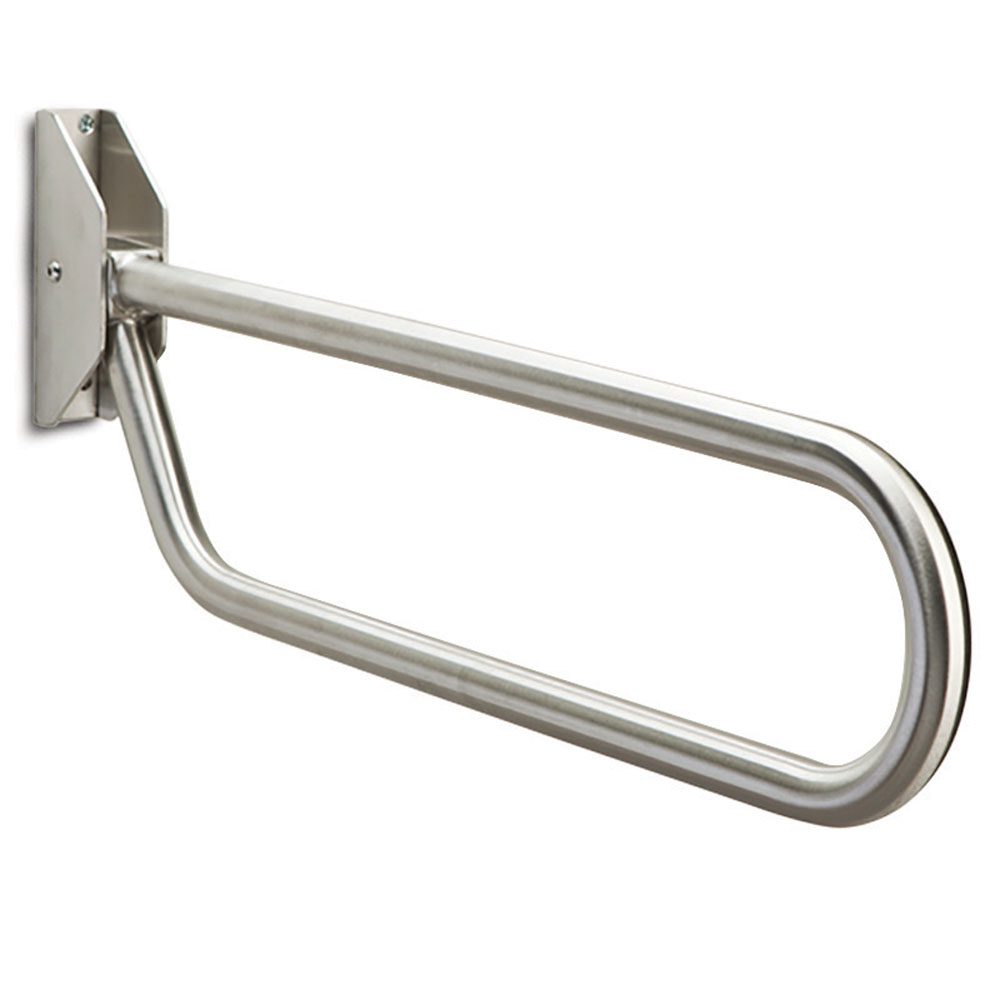
At the toilet, a rail has to help with lowering onto a low seat and pushing back up, which is the job toilet grab rails are made for. The range includes many shaped toilet rails, each with concealed flanges covering the fixing points. Several descriptions ask you to specify dimension B to suit the cistern and warn that a rear rail can obstruct the seat or cistern, which is why the cistern and the space around the pan need measuring first. Where space is limited, a drop down rail mounts on the wall and swings back when not in use; the stainless steel version locks upright when vertical.
Some walls are not suitable, or the household cannot drill. The over toilet aids range offers support arms that need no wall fixing. The Rebotec Brest is a free-standing toilet seat raiser on a large base with individually adjustable legs, while the Darts Toilet Aid attaches using the existing toilet seat fixings and has arms that lift back separately. The Throne Toilet Aid 3 in 1 has arms that fold down to assist side transfers.
In the shower
Bathroom grab rails in a shower have to work with wet hands and, often, a seat. Whether the person stands or sits changes where their hand falls, so it helps to decide on the seating first. The shower chairs range includes a swivel chair that locks in both transfer and showering positions and models with angled arms that assist transfers. For the rail itself, the straight stainless steel rails are described as suitable for wet and dry areas, and the 32 mm model comes in custom lengths.
At the bath
Getting over the side of a bath is a different movement again: one foot is lifted while weight shifts. The range has dedicated bath/shower rails for the wall, and a clamp on rail that grips the bath edge with a rubber lined screw clamp and offers two grip heights. Read its limits closely, because it is described as suitable only for downward pressure.
For people who sit to get in, bath boards and transfer benches often carry their own rail. The bath transfer benches have an integrated grab rail that you specify for the left or right side, and the Kingfisher Bathboard has a removable grab rail and suction cup feet.
At the entry and along the way
The bathroom is rarely the only place a hand is needed. A step at the front door, a hallway or a sunken room can all call for a rail. My Aged Care’s home modifications list names internal and external handrails, ramps and non-slip materials alongside grab rails in the shower or bathroom, which is a useful reminder to look at the whole route, not just one room.
A rail is only as good as the wall behind it and the hand that reaches for it.
Heights, walls and fixing: why professionals set them
The right position at home depends on the person’s reach, grip, height and the way they move, so the heights below are a guide rather than a rule for a private home. An OT can assess the person and the room and mark where each rail should go, and a qualified tradesperson fixes it. Every fixed rail and drop down rail in the Allcare range says the same thing in its description: it must be installed by a qualified tradesperson.
For public buildings, grab rail positions are set by Australian Standard AS 1428.1. A South Australian Government Equipment Program guide for prescribers states that AS 1428.1 recommends the horizontal section of a toilet grab rail be 800 to 810mm high, with the vertical section running from 800mm to at least 1400mm from the floor. In showers, the same guide says the standard recommends a continuous horizontal rail starting within 100mm of the shower entrance, at a height of 800 to 810mm for seated users. It also notes that these are not requirements in private homes, where the figures serve as a guide together with clinical reasoning about each person’s needs. The guide was released in 2013, before the current 2021 edition of the standard.
The wall matters as much as the rail. Australia’s Livable Housing Design Standard sets out reinforcement for the walls beside the toilet, shower and bath so grab rails can be fixed later, unless the wall is concrete, masonry or another material that can hold them without it. Not every home was built to that standard, which is one more reason to have the wall checked by someone qualified before a rail goes up.
Grab rails and funding
For older Australians, the Assistive Technology and Home Modifications scheme lists grab rails in the shower or bathroom as a home modification. Under that scheme, your provider arranges an OT assessment to work out what you need, gets your agreement, and coordinates installation by a qualified person.
NDIS participants follow a similar path. The NDIS describes minor home modifications as straightforward changes that do not affect the structure of the home, and says it only pays for work completed by qualified tradespeople. Our guide to home modifications explains how fixed changes differ from equipment you can take with you, and the fall prevention equipment guide covers aids for the rest of the house.
Working out where rails should go? Talk to the team about rails, toilet frames and bath seats that fit your plan.
Frequently Asked Questions
Can grab rails go in a rented home?
A fixed rail changes the property, so the owner’s agreement comes first. The NDIS also says it can only fund modifications to a home you own or one whose owner agrees. If the owner says no, the wall-free toilet frames and bath options described above are worth raising at the OT assessment, since they can leave with you when you move.
What does “opposite dimensions” mean on a toilet rail listing?
Several toilet rail listings name a second code that is “as per” the first “with opposite dimensions”, meaning the same rail with its measurements reversed. If your OT’s plan puts the rail on a particular side or needs particular proportions, quote both codes when you call and the team can confirm which one matches the plan.
Which finishes and diameters are available?
The shaped toilet and bath/shower rails are 32 mm marine grade stainless steel with a brushed satin finish and are made in Australia. A 25 mm stainless steel straight rail has a polished finish. The powder coated steel drop down rail has a 25 mm tube, while the stainless drop down rail is marine grade and locks upright.
Can a toilet roll holder attach to a grab rail?
Yes. The Toilet Roll Holder fixes to 32 mm drop down and fixed rails with heavy duty adhesive tape, and the chrome holder swivels in a plastic moulding. The description says it positions toilet tissue in a more accessible location. Check the rail’s diameter before ordering, because the holder is listed for 32 mm rails.
How do I order rails once the plan is done?
Orders are taken by phone, email or in person, so call 1300 767 777 or email [email protected] with the product names, sides and any custom lengths from your OT’s report. Allcare delivers Sydney wide and arranges freight within NSW, and the rails still need fixing by your own qualified tradesperson.
Planning rails around the person
Careful grab rail placement goes unnoticed until the moment a rail is needed, and then it is the first thing a hand finds. Write down the movements that feel unsafe today, take that list to the assessment, and order once the positions are marked on the wall.
Related services
Bring your OT’s rail plan to the Liverpool showroom at Shop 7 inside Northumberland Arcade, 230 Northumberland Street, Liverpool, or call 1300 767 777 to ask about grab rails, toilet frames and bath boards.
This guide is general information, not medical advice. Read our disclaimer.