A wheelchair ramp bridges a step, kerb, doorway or vehicle floor so a wheelchair can roll across instead of being lifted. Allcare Warehouse stocks portable ramps that fold, roll up or telescope, so you can carry them to where they are needed and store them afterwards. The range includes Decpac ramps made from fibreglass and carbon fibre, aluminium bi-fold and roll-up ramps, and telescopic channel ramps. Below we explain how each type works and what to measure first.
Why we don't display Prices ?
In this competitive market, we do the research on your behalf for the best prices and stock availability from different suppliers. Our product sourcing team is on constant lookout for the best deals from our suppliers, and we pass these great discounts on to you.
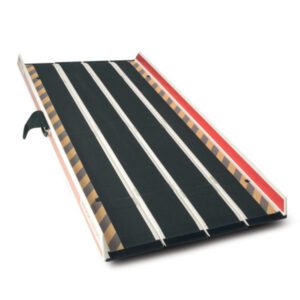
Decpac ramps fold with a concertina action into a single compact unit and have a non-slip surface with protective pads at the top and base. Their maker states they are tested to Australian Standards. They come in four types: Personal ramps for small areas and obstacles, Multipurpose ramps that are longer and wider for commercial use and travel, Senior ramps in a wide choice of lengths, and Edge Barrier ramps with raised sides for buildings, vehicles and public transport. Specify the type and length when you ask.
Bi-fold ramps
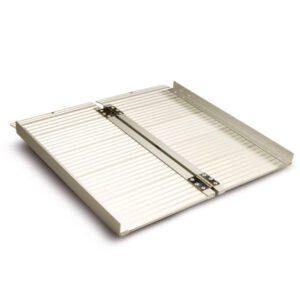
The aluminium Bi-fold Ramp folds in half and has a carry handle. It is designed for wheelchairs that need an attendant (a carer who pushes the chair) to get up the ramp.
Portable ramp choices: telescopic and roll-up
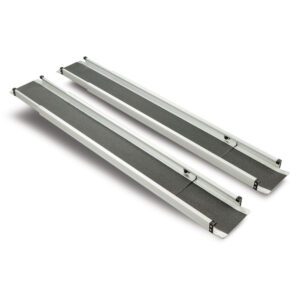
Telescopic ramps are a pair of narrow channels, one for each side of the chair, that slide out to suit the height you need and lock together when not in use. Each weighs 3.2 kg. The Roll-up Ramp rolls into a compact unit and has side clamps that lock the rails in place, with an inner width of 760 mm.
Threshold ramp needs and small steps
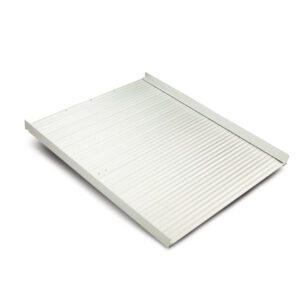
For a door sill or one small step, people often look for a threshold ramp. Our range does not include fixed threshold ramps, but a short portable ramp, such as the Decpac Personal type, is made for small areas and obstacles. For permanent changes at home, read our guide on home modifications vs equipment.
What to measure first
Before choosing a wheelchair ramp, measure:
the height of the step or rise from the lower ground to the top
the clear space at the top and bottom for the chair to turn
the width between the wheels of your chair, against the ramp's inner width
the maximum user weight listed on each ramp
A longer ramp gives a gentler slope over the same rise. Healthdirect advises using the right mobility aid and getting it fitted safely, so an occupational therapist can help you choose the length. Check the inner width against your chair from our manual wheelchairs range, and if you ride one of our mobility scooters, call us before you buy. The National Disability Insurance Scheme (NDIS) lists short portable ramps as low-cost assistive technology, and our NDIS hub explains buying through a plan. More options are in the full mobility aids range.
Frequently asked questions
Which wheelchair ramp suits a car or van?
The Decpac Edge Barrier type is described for access to vehicles, buses and trains, and its edge barriers add security on the way up. The Multipurpose type is longer and wider for travel. The Bi-fold Ramp is another option when a carer pushes the chair up.
How heavy are the ramps to carry?
The Telescopic Ramps weigh 3.2 kg each and come as a pair, and the Roll-up Ramp weighs 6.9 kg. Weights for the Decpac and Bi-fold ramps depend on the size, so call 1300 767 777 with the length you need and we will check.
Can I see a ramp before buying?
Some ramps can be seen at our Liverpool showroom, Shop 7 inside Northumberland Arcade, 230 Northumberland Street. Ramps come in several lengths, so call ahead and tell us the height you need to cover, and we will let you know what is on display.
Shopping Cart
We use cookies to understand how this site is used and to improve it.
Privacy policy